
COMPATIBILITY · TWO COMPLETE CHARTS · 10 MIN READ
Zi Wei Dou Shu compatibility.
Compare needs, support and friction.
Read each person first, compare the relationship second, and let consent, safety, and behavior remain decisive.
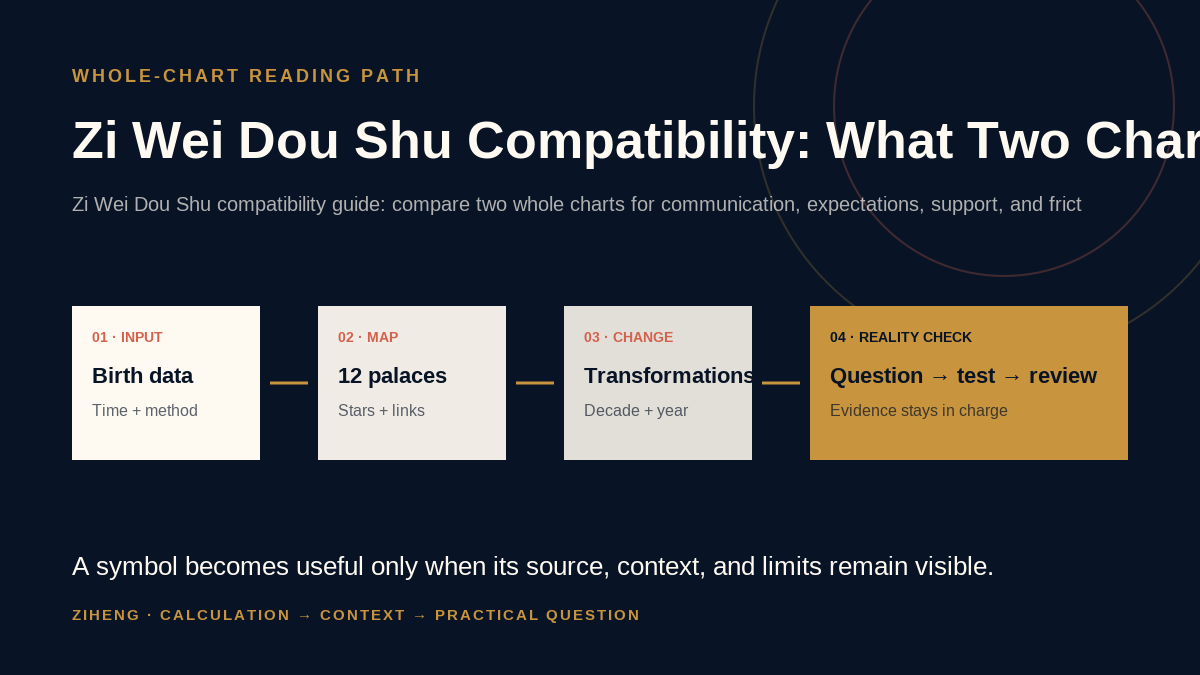
Direct answer: Zi Wei Dou Shu compatibility is most useful when it compares two complete natal charts and turns symbolic differences into specific conversations. It should not reduce two people to zodiac animals, one Spouse Palace, or a percentage. First read how each person makes decisions, restores energy, handles responsibility, exchanges resources, and responds to pressure. Then compare expectations and active timing.
The four-layer comparison
| Layer | Chart evidence | Relationship question |
|---|---|---|
| Self | Life, Fortune, Body, major stars | How does each person process decisions and recover? |
| Commitment | Spouse with opposite and wider triangle | What counts as reliability, closeness, space, and commitment? |
| Coordination | Friends, Siblings, Career, Property | How are work, money, home, and responsibility negotiated? |
| Timing | Each decade and annual layer | Is current pressure temporary, structural, or unrelated to the chart? |
Calculate both charts independently
Use the same disclosed time-zone and birth-time policy, but do not force the charts into one combined verdict. Birth-time uncertainty in either chart must be marked. Identify stable conclusions that remain across plausible windows and separate them from palace placements that could change.
Worked example: different communication speeds
Person A has a pattern that favors private processing before commitment; Person B has a pattern that seeks active discussion and fast clarification. Neither style is superior. The risk appears when silence is interpreted as rejection and questions are interpreted as pressure. The useful compatibility output is an agreement: define reflection time, schedule the return to the topic, and state what decision is actually required.
Worked example: support versus control
One fictional chart emphasizes guidance and standards; the other emphasizes autonomy and experimental learning. Advice may be offered as care but received as control. A score cannot capture that difference. A real test asks permission before advising, distinguishes safety requirements from preference, and reviews whether the agreement changed behavior.
Money, work, and domestic responsibility
Many apparent compatibility disputes concern resources and labor. Compare Wealth and Career for exchange and standards, Property for the shared base, and Fortune for capacity. Record who owns recurring tasks, how financial decisions are made, and what threshold requires joint approval. Astrology cannot determine a fair agreement; it can only make hidden expectations easier to name.
Timing without relationship prediction
An annual Partnership emphasis may support a review of commitment, while Career or Property emphasis may bring workload and living arrangements to the foreground. It cannot guarantee meeting, marriage, separation, or reconciliation. Never use timing to pressure another person or delay safety support.
A responsible compatibility result
The final output should contain agreements, tensions, unknowns, and one conversation plan. It should cite palace and timing evidence, then place the practical translation in a separate paragraph. Consent, observed behavior, direct communication, and qualified help always outrank symbolic fit.
Build an evidence ledger for each person
For every comparison, record the source before the interpretation: Person A's palace and star, Person B's corresponding palace and star, any natal Four Transformation, and the current timing layer. Then write what was actually observed. If the behavior does not fit the symbolic translation, revise the translation rather than treating disagreement as hidden proof.
Five conversations a useful comparison can support
- Time: how much notice, private processing, and shared time does each person need?
- Money: what is individual, shared, disclosed, and jointly approved?
- Care: which forms of support are welcome, and which feel intrusive?
- Autonomy: where is consultation required, and where can each person decide alone?
- Repair: how is a paused conflict reopened, and what counts as a completed repair?
When timing layers disagree
One person may be in a decade that rewards external expansion while the other is consolidating home, health, or resources. That difference is not automatic incompatibility. It does create a planning problem: expectations about travel, workload, spending, and availability need dates and boundaries. If an annual layer adds pressure, define a review window instead of treating temporary strain as a permanent relationship identity.
Red lines are not chart questions
Coercion, violence, stalking, financial control, threats, and repeated dishonesty are not softened by favorable stars or compatibility language. Seek appropriate safety, legal, medical, or counseling support. A symbolic chart must never be used to pressure someone to remain in a relationship or to excuse harmful behavior.
Worked decision scene: relocation and workload
In a fictional comparison, one chart places current emphasis on Travel and Career while the other emphasizes Property and Fortune. A score would call this a mismatch. A whole-chart reading identifies a negotiation: one person needs external movement and visible responsibility; the other needs a stable base and predictable recovery. The pair tests a six-month arrangement with a travel ceiling, protected home days, separate discretionary budgets, and a monthly review. The useful result is the agreement and its evidence, not a label about destiny.
How to review a disagreement
Write each person's request without chart language. Mark what is a need, preference, boundary, or negotiable proposal. Only then use the palace network to look for a missed category such as money, family, autonomy, public role, or recovery. If the comparison creates certainty about the other person's motives without their input, stop and return to direct conversation.
A good comparison ends with a shared action, a review date, and permission for either person to revise the agreement when evidence changes.
FROM GUIDE TO YOUR CHART
Where does this show up?
Find it in your own chart.
Use the free chart to locate the evidence behind “Zi Wei Dou Shu Compatibility: A Two-Chart Relationship Method.” Explore the relationship palaces and observable behavior, then compare the interpretation with your actual situation.
PUT THE QUESTION BESIDE YOUR OWN MAP
Your chart is the next step.
The complete map is free.
The full twelve-palace chart is free. Your next screen keeps “Zi Wei Dou Shu Compatibility: A Two-Chart Relationship Method” as the active question and shows the placements used to answer it.
Frequently asked questions
Can Zi Wei Dou Shu produce a compatibility percentage?
A percentage hides the specific needs, expectations, and behaviors that matter. Ziheng uses a two-chart evidence map instead of a score.
Can compatibility predict marriage success?
No. It cannot predict whether a relationship will begin or last. Consent, safety, behavior, shared values, communication, and circumstances remain decisive.
What if one birth time is unknown?
Keep the uncertainty explicit, compare plausible windows, and limit conclusions that depend on changing palace placements.