
財帛宮 · WEALTH PALACE EVIDENCE GUIDE · 10 MIN READ
Wealth Palace meaning.
Income patterns and resources.
Connect Career, Wealth, Travel, Property, and timing to see how value moves and where it leaks.
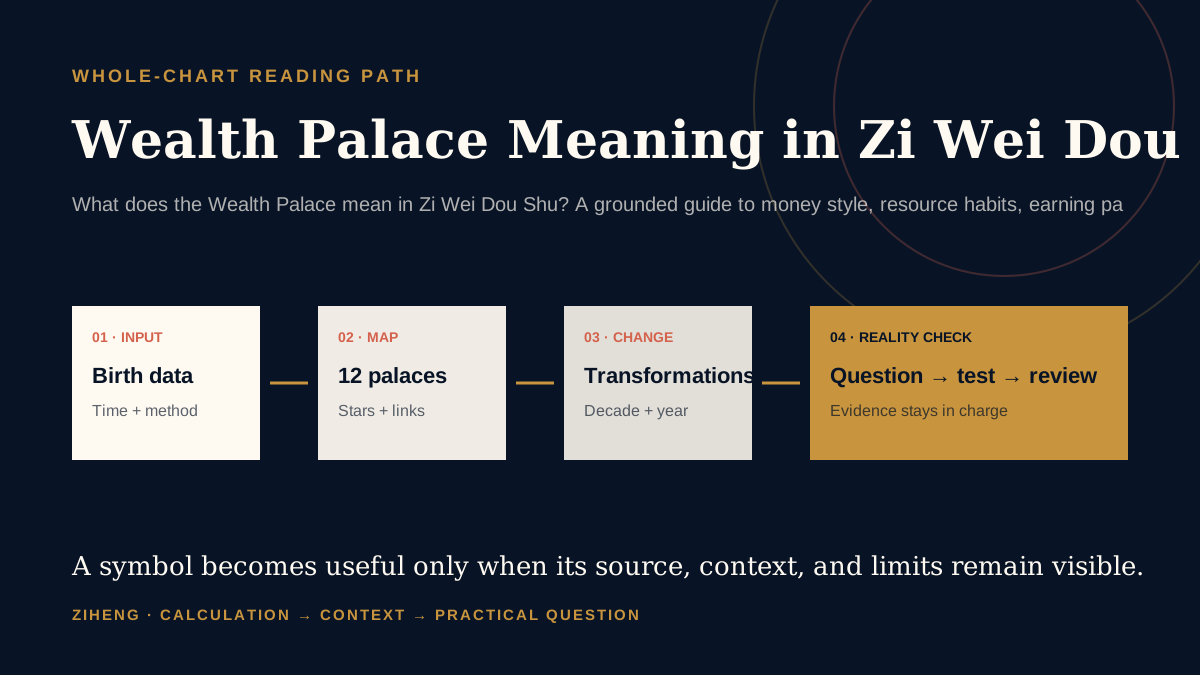
Direct answer: the Wealth Palace (財帛宮) is a symbolic domain for value exchange, allocation, retention, and resource habits. It cannot calculate future income or identify a guaranteed investment. A useful reading connects what Career produces, what the external market recognizes through Travel, what Wealth captures, and what Property or Fortune must preserve.
The value return loop
| Palace | Role in the loop | Observable evidence |
|---|---|---|
| Career | Contribution and repeatable responsibility | Completed work, quality, delivery capacity |
| Travel | External market and response | Qualified demand, feedback, distribution |
| Wealth | Exchange, pricing, collection, allocation | Compensation, payment timing, retained margin |
| Property | Buffers and operating foundation | Runway, systems, home or work stability |
| Life and Fortune | Direction and sustainable capacity | Priority, attention, recovery, trade-offs |
Read stars as resource styles, not bank balances
A managerial star can raise questions about stewardship and reserves; an output-oriented star can foreground production and visibility; a mobile or exploratory pattern can emphasize varied channels. Four Transformations add movement, responsibility, recognition, or friction. None of them supplies a currency amount. The question is how the style operates in the palace network and current timing.
Worked example: strong delivery, weak retention
A fictional freelancer has visible Career evidence and frequent client work, but the Wealth Palace connects to a demanding revision pattern. The conclusion is not “good wealth luck.” The evidence suggests that value is produced but not retained. The practical test is a fixed scope, a deposit, a revision boundary, and four weeks of tracking true delivery cost and payment time.
Worked example: resources exist but do not circulate
Another fictional chart emphasizes preservation and foundations. Savings and skills exist, yet no defined offer reaches an external audience. Here the risk is not reckless spending but excessive protection. A bounded experiment allocates a fixed amount of time and budget to one offer, one audience, and one response metric while preserving the essential reserve.
Timing changes the foreground, not financial reality
A decade or annual Wealth emphasis can justify reviewing pricing, compensation, debt, buffers, or allocation. A Career or Travel period may focus attention on delivery or market access first. Timing does not guarantee a raise, sale, inheritance, or return. Contracts, taxes, credit, insurance, and investments require real documentation and qualified advice.
Five questions worth taking to the free chart
- What repeatable contribution does Career actually support?
- Where does Travel show real external response rather than imagined demand?
- What does Wealth reveal about pricing, collection, allocation, or volatility?
- Which foundation must Property protect before expansion?
- Does the active decade reinforce the loop or expose a missing link?
Use an evidence ledger
For each interpretation, write the palace, star, transformation, and timing source. Then write the practical translation separately and choose a metric: hours, completion, qualified conversations, payment delay, retained margin, buffer, or recovery capacity. Review the result before expanding the claim.
Important limits
Zi Wei Dou Shu is not financial advice and should not be used to select securities, credit, insurance, tax structures, or regulated products. It can organize questions about work and resources, but it cannot promise income, prevent loss, or replace qualified professionals.
Four Transformations change the resource question
Lu can foreground flow, access, accumulation, or an opportunity to make value more usable. Quan can bring responsibility, control, negotiation power, or a need to define ownership. Ke may make a method, credential, explanation, or evidence trail more visible. Ji can reveal friction, fixation, leakage, disputed terms, or a resource problem that is difficult to ignore. None of these meanings is complete until the transformed star and its palace are named.
Different work models need different evidence
An employee can review compensation, role scope, promotion criteria, benefits, and the cost of sustained workload. A freelancer needs project margin, revision limits, payment delay, lead quality, and income concentration. A founder needs demand, delivery capacity, runway, repeat purchase, and legal obligations. A household may focus on reserves, shared expenses, care work, and decision thresholds. The Wealth Palace does not collapse these models into one definition of success.
A 30-day money-pattern audit
- Choose one value stream rather than judging all finances at once.
- Record true hours, direct costs, unpaid coordination, and payment date.
- Separate revenue from retained resource after tax, delivery, and recovery costs.
- Identify one leak caused by scope, delay, volatility, or an unclear agreement.
- Change one rule and review whether the result improves after four weeks.
What to do when the chart and numbers disagree
Trust the documented numbers. A favorable-looking configuration does not make an unprofitable offer sustainable, and a demanding configuration does not cancel a well-run system. Use the symbolic reading to generate a question, then let accounting records, contracts, market response, and professional advice determine the decision.
Decision scene: a higher salary with a higher operating cost
A fictional employee receives a better offer while the active chart foregrounds Career and Wealth. The reading does not declare the offer fortunate. It creates a comparison sheet: after-tax pay, commute, expected overtime, learning value, manager quality, benefits, recovery time, and the cost of leaving. A higher number can still reduce retained capacity. The decision follows verified terms and personal constraints, while the palace network makes sure hidden resource costs are not ignored.
Decision scene: concentration risk in a small business
A fictional founder has strong external demand but most revenue comes from one client. Travel and Career look active, yet Property lacks a stable operating buffer. The bounded action is to document the delivery system, define a reserve target, and test a second acquisition channel without risking current obligations. No star can tell the founder that a client will stay or a campaign will succeed.
FROM GUIDE TO YOUR CHART
Where does this show up?
Find it in your own chart.
Use the free chart to locate the evidence behind “Wealth Palace Meaning in Zi Wei Dou Shu: Money Patterns & Evidence.” Explore the Career, Wealth, and Travel loop, then compare the interpretation with your actual situation.
PUT THE QUESTION BESIDE YOUR OWN MAP
Your chart is the next step.
The complete map is free.
The full twelve-palace chart is free. Your next screen keeps “Wealth Palace Meaning in Zi Wei Dou Shu: Money Patterns & Evidence” as the active question and shows the placements used to answer it.
Frequently asked questions
Can the Wealth Palace predict how rich I will be?
No. It is a symbolic resource domain. Use it to examine contribution, exchange, retention, buffers, and timing rather than a future amount.
Which palaces should be read with Wealth?
Start with Career, Travel, Property, Life, and Fortune, then add the active decade and annual layer.
Can I use the Wealth Palace for investment decisions?
No. Investments require regulated information, risk assessment, and qualified advice where appropriate.