
CAREER PALACE · GUAN LU · 9 MIN READ
Career Palace meaning.
Work style and contribution.
The useful question is not “Which job is destined for me?” It is “What kind of contribution can I sustain, where is it valued, and what needs testing?”
What the Career Palace means—in one answer
The Career Palace (官祿宮, Guan Lu) describes work and public contribution in the traditional Zi Wei Dou Shu system. It can help organize questions about responsibility, preferred working conditions, recognition and professional friction. It cannot determine your occupation, salary or promotion on its own. In Purple Star Astrology, the same placement can play out differently for an employee, a freelancer, a caregiver or a business owner.
Start with the role you actually perform. Are you paid to make accurate decisions, coordinate people, produce original work, sell a service or keep a system reliable? Then read the palace as a hypothesis about that contribution. A symbol becomes useful when it points to a question you can test—not when it labels you permanently.
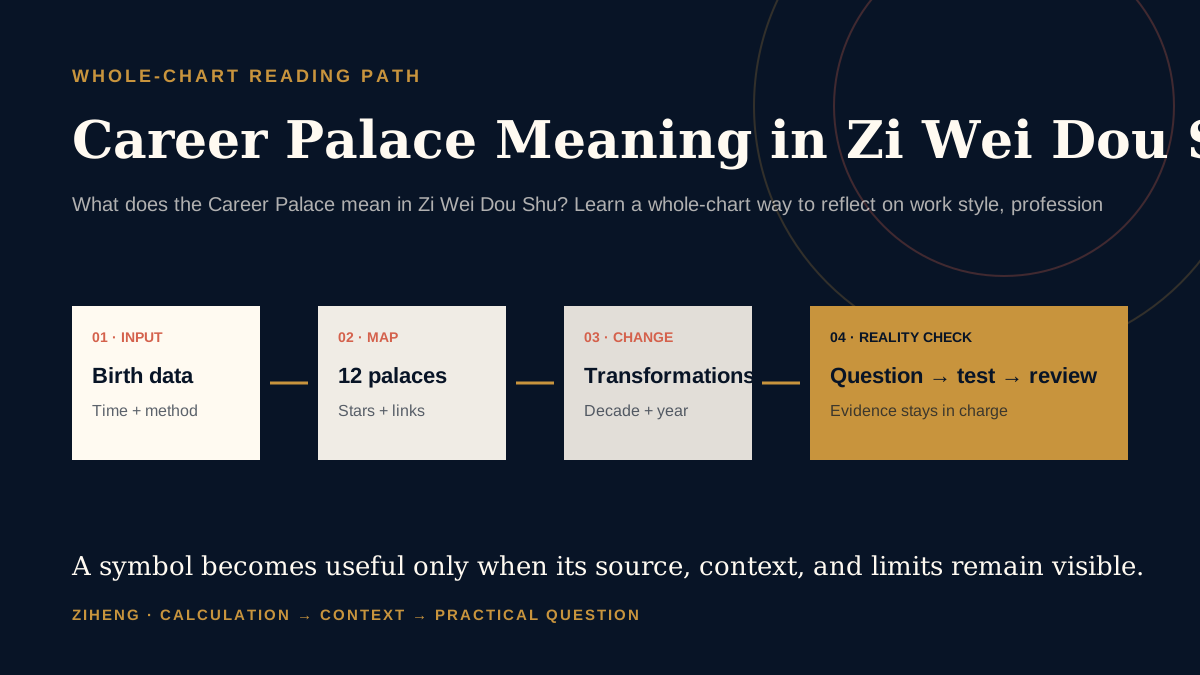
Read four connected domains before naming a job
| Chart domain | Question to ask | Evidence outside the chart |
|---|---|---|
| Life | Does this work fit the way I make decisions and recover? | Tasks you repeat willingly; conditions that drain you. |
| Career | What responsibility and contribution are emphasized? | Deliverables, standards, decision rights and workload. |
| Wealth | How is that contribution exchanged for resources? | Pay structure, payment reliability and operating costs. |
| Travel | Where does the outside world recognize it? | Client feedback, hiring demand and the environment you enter. |
Life, Wealth and Career form a commonly used connected reading; Travel adds the external setting. Learn the Life Palace, Wealth Palace and Travel Palace before translating a star into an industry. A good result in one domain does not cancel a constraint in another.
Stars describe functions, not a guaranteed profession
Traditional Wu Qu language often emphasizes measurable output, resources and standards. Tian Ji language emphasizes adaptation, systems and planning. Ju Men language brings questions of explanation, scrutiny and disagreement. These are reading prompts, not instructions to become an accountant, engineer or lawyer. The same function can exist in operations, design, education, sales or a non-paid role.
Check whether a major star is actually in the palace, whether the palace is empty, what supporting stars are present and where each transformation originates. Do not merge natal, decade and annual transformations into one undated “lucky” label. The Four Transformations guide explains why source and timing matter.
Find my Career, Wealth and Travel palaces
Worked scenario 1: the specialist who is offered management
Traditional interpretation: measurable contribution and accountability deserve attention. Practical translation: compare two paths: senior specialist and people manager. Alex asks for the first 90-day objectives, staffing authority and the proportion of hands-on work. If the title improves but decision rights do not, the role may increase workload without increasing useful influence.
Small test: lead one bounded project before accepting a permanent management role. Record the time spent on execution, coordination and conflict resolution. Review whether energy, feedback and output improve. The test can disagree with the symbolic reading; that is a reason to revise the interpretation, not to ignore the evidence.
Worked scenario 2: the planner considering freelance work
Traditional interpretation: changing systems and external settings may be relevant themes. Practical translation: separate skill demand from the appeal of independence. Mina interviews potential clients, defines one service, sets revision limits and calculates how much unpaid coordination the service involves. Wealth is read as the exchange question, not as a promise of revenue.
Small test: where employment terms permit, run a limited pilot with clear scope. Compare client response, delivery time and repeat interest. A written plan and actual demand are stronger reasons to change work arrangements than a symbolic timing label.
When timing changes, what should actually change?
A decade highlights a longer context; the selected year adds a shorter review lens. Keep them separate from the natal chart. If the active layer emphasizes Travel, consider the external environment. If it emphasizes foundations, examine the home or working setup. Neither means an event must occur. The 10-year luck cycle guide shows how to read the current and next stage without treating an age boundary as a deadline.
For a job change, compare the present role with a specific alternative: contribution, compensation, autonomy, learning, workload and practical constraints. “This year looks favorable” is not a substitute for a written offer. If the birth-time window is uncertain, avoid precision that the input cannot support.
A 30-day career review you can use now
- Week 1: collect evidence. Record tasks, interruptions and feedback. Identify one useful contribution and one recurring source of friction.
- Week 2: compare conditions. Write down what would have to change: scope, manager expectations, tools, visibility, compensation or location.
- Weeks 3–4: test one change. Try a clearer brief, a bounded project, a portfolio example or a conversation about decision rights. Set a review date and a measure of success.
For profession fit, use career environment comparison; for collaboration, read the Friends Palace. These questions should help you distinguish an environment problem from a skill problem rather than making every obstacle sound like fate.
What to inspect before choosing a report
Generate the free chart and identify your actual placements. Ask whether its complete insight connects to your experience and whether the evidence labels make sense. Inspect the fictional report sample to see the writing format; the sample is not your result. A paid synthesis is an optional way to organize the evidence and action plan, not a stronger guarantee about the future.
FROM GUIDE TO YOUR CHART
Where does this show up?
Find it in your own chart.
Use the free chart to locate the evidence behind “Career Palace Meaning in Zi Wei Dou Shu: Work, Roles & Timing.” Explore the connected palaces and active timing, then compare the interpretation with your actual situation.
PUT THE QUESTION BESIDE YOUR OWN MAP
Your chart is the next step.
The complete map is free.
The full twelve-palace chart is free. Your next screen keeps “Career Palace Meaning in Zi Wei Dou Shu: Work, Roles & Timing” as the active question and shows the placements used to answer it.
Frequently asked questions
What does the Career Palace mean in Zi Wei Dou Shu?
The Career Palace, or Guan Lu, is a traditional lens on work, responsibility, contribution and public role. It is read with Life, Wealth, Travel, transformations and timing, not as a standalone job prediction.
Can the Career Palace tell me when to change jobs?
It cannot verify a future job offer or an exact date. Use the active decade and selected year to frame a review, then compare a written offer, financial runway, role expectations and market evidence.
What if my Career Palace has no major star?
An empty Career Palace does not mean no career. Inspect the opposite palace, connected palaces, supporting stars and transformations. Keep borrowed-star interpretation distinct from stars actually placed in the palace.
Is the career reading free?
The full twelve-palace chart and a personal preview are free. Optional paid reports add synthesis and planning detail; no payment is needed to inspect the chart first.