
DA XIAN · DECADE AND YEAR · 9 MIN READ
Your 10-year cycle.
A context—not a countdown.
Locate the age range actually calculated for your chart. Then compare the active palace, connected domains and selected year before turning a theme into a plan.
What is a 10-year luck cycle?
In Zi Wei Dou Shu, Da Xian (大限) associates successive ten-year age ranges with the palace structure. The natal chart remains the base map; the active decade provides an additional context for reading it. A Career decade can prompt questions about responsibility, while a Travel decade can draw attention to external settings. These are traditional themes—not evidence that a job change, move or other event will happen.
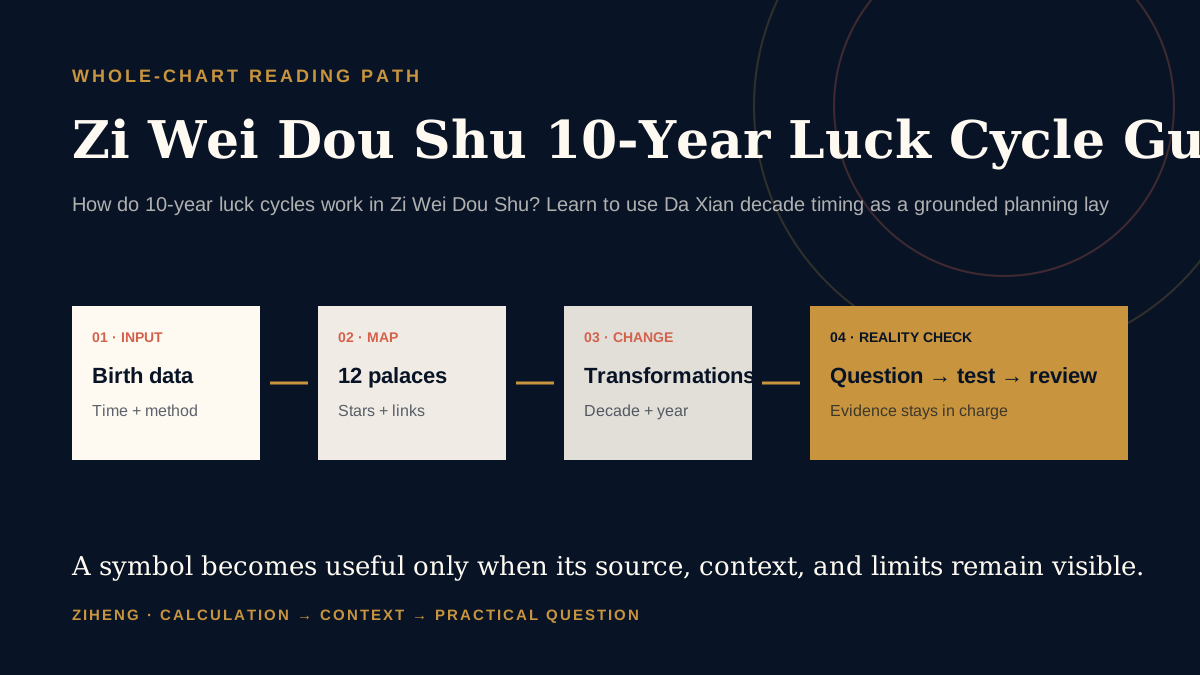
The useful reading has three layers: what stays relatively stable in the natal map, what the decade emphasizes, and what the selected year adds. If the layers do not support the same theme, show the disagreement rather than compressing everything into a single “good luck” rating.
First, find the right age range
Do not assume everyone starts a cycle at birth or at the same birthday age. Use the displayed start and end ages on your calculated chart. The first range and sequence follow the chosen calculation convention; copying another person's ranges can put your current decade in the wrong palace.
Ziheng's English Zi Wei tool uses lunar-year nominal age for the annual and decade display, with an annual reference date of July 1 in the selected year. This is not the same as completed birthday age. Near a boundary, compare the recorded input, reference date and age convention before calling two tools inconsistent. Changing the planning year changes the timing view; it does not change the natal birth record.
Read the published calculation method if the range differs from another calculator. If your birth time is uncertain, the birth-time uncertainty guide explains why precision needs limits.
Read the three layers separately
| Layer | Locate this | Do not infer this |
|---|---|---|
| Natal | Life and the palaces connected to your question; placed stars and natal transformations. | A guaranteed personality, profession or outcome. |
| Decade | The active age range, palace and relevant connections. | Ten identical years or an event on the first day of the range. |
| Annual | The selected year, annual palace and source-labelled transformations. | A verified promotion, income amount, relationship result or exact event date. |
Locate my current and next decade
What does the active palace add?
A palace gives you a domain to examine, not a compulsory life event. A foundations-focused phase may become a question about a workable home, schedule or workspace. A Career focus may ask how responsibilities and recognition fit together. A Wealth focus may prompt a review of income arrangements and resource use. A Friends focus can lead to a collaboration and boundary review. The same domain can be lived differently according to life circumstances.
Return each domain to the whole chart. For work, connect Career with Wealth and Travel. For relationships, use the relationship timing guide alongside behavior and communication. A strong-looking timing label cannot establish consent, remove a practical constraint or prove an opportunity exists.
Worked scenario 1: entering a Travel-focused stage
Traditional theme: external environments deserve attention. Reality check: compare the role's deliverables, travel load, support network, costs and written terms. Jamie might learn that the new title is attractive but leaves less time for the work they do well. A different client, team or distribution channel could test the same external theme without relocation.
Plan: interview the future team, clarify travel expectations and run a short project if possible. Review at 30 and 90 days. The symbolic layer organizes the questions; actual conditions decide whether the change is sensible.
Worked scenario 2: leaving a foundations-focused stage
Traditional theme: foundation and public contribution are different emphases. Reality check: Rae wants to accept a larger project but has limited time. Instead of treating the new range as permission to overload the calendar, Rae keeps the reliable routine, negotiates scope and tests whether the project creates useful experience.
Plan: protect existing commitments, name the new contribution and set a workload limit. Revisit the trade-off after the first delivery. A transition is a planning horizon, not a deadline to transform every area of life.
Turn one, three and five years into different questions
- Next year: choose one practical experiment and a review date. Use the annual layer to organize attention, not to promise the result.
- Next three years: identify a skill, relationship practice or working system worth building repeatedly. Specify what real evidence would show progress.
- Next five years: consider optionality. What commitments would you still want if the symbolic reading proved unhelpful?
These are planning horizons you choose, not three separate predictive products. Recalculate or recheck assumptions if birth records change. Track the date, question, evidence and actual outcome; do not rewrite a prior interpretation after the fact to make it appear accurate.
Add the year only after the decade is clear
Use the remaining 2026 stage and the 2027 annual guide to understand annual layers. Then use monthly timing for a shorter review rhythm. Record which transformation belongs to which layer; identical star names do not make their sources interchangeable.
Da Xian is not BaZi Da Yun
Both are often described in English as ten-year luck cycles, but Zi Wei uses palace-based decade layers and BaZi uses its own luck pillars and starting calculation. Do not force equal ages or translate one palace into one Ten God. The BaZi luck-pillar guide explains the separate system. Agreement can suggest a useful question; disagreement should remain visible.
Before paying for more detail, inspect your free natal map, active range and annual evidence. The report sample is a fictional format demonstration. It can help you judge readability, not confirm a personal forecast.
FROM GUIDE TO YOUR CHART
Where does this show up?
Find it in your own chart.
Use the free chart to locate the evidence behind “Zi Wei Dou Shu 10-Year Luck Cycle: Read Da Xian & Transitions.” Explore the current decade and annual layer, then compare the interpretation with your actual situation.
PUT THE QUESTION BESIDE YOUR OWN MAP
Your chart is the next step.
The complete map is free.
The full twelve-palace chart is free. Your next screen keeps “Zi Wei Dou Shu 10-Year Luck Cycle: Read Da Xian & Transitions” as the active question and shows the placements used to answer it.
Frequently asked questions
What is a 10-year luck cycle in Zi Wei Dou Shu?
Da Xian is a sequence of calculated ten-year age ranges associated with palaces. It adds a timing context to the natal chart. A palace label is not a guarantee that a particular event will occur.
Do all people start their first cycle at the same age?
No. Use the age ranges and direction calculated for the individual chart. Do not replace them with universal 0–9, 10–19 or birthday-based ranges.
Why does the age on the chart differ from my birthday age?
The English Zi Wei tool displays lunar-year nominal age for its annual and decade reference, not completed birthday age. Its annual reference date is July 1 of the selected year. Check the displayed convention before comparing tools.
Is Zi Wei Da Xian the same as BaZi Da Yun?
No. They are different calculations and symbolic structures. Compare them only after each chart is calculated independently; similar ten-year wording does not make their start dates or meanings equivalent.