
REMAINING 2026 · REVIEW AND TRANSITION · 11 MIN READ
The rest of 2026 is a review window.
Finish the right work before adding a new forecast.
A late-year reading should not pretend January is still ahead. Review what 2026 actually produced, then prepare the hand-off into 2027.
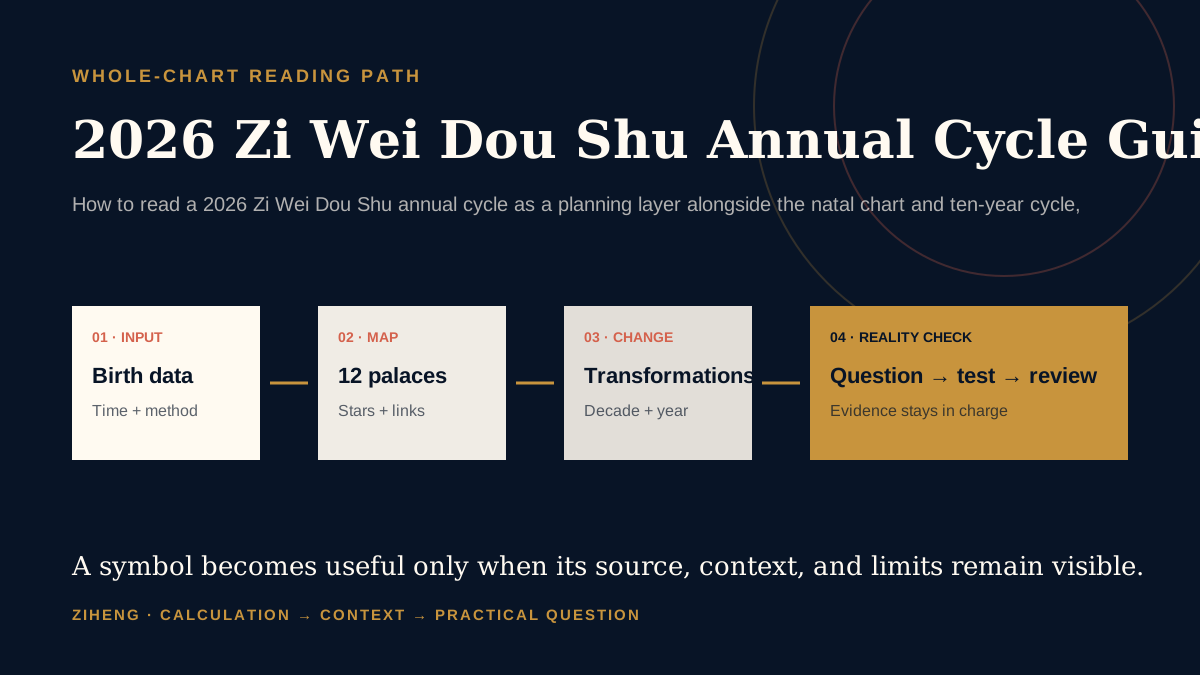
Direct answer: with 2026 already underway, the useful Zi Wei Dou Shu question is no longer “What will the whole year bring?” It is “Which annual themes have been observable, what remains unfinished, and what should be closed or protected before 2027?” Keep the natal chart and current decade underneath the annual layer, then compare the original interpretation with evidence from work, money, relationships, and capacity.
Start with a dated reality check
Write down the 2026 annual Life Palace, the annual Four Transformations, and the active decade. Beside each symbolic statement, record one observable event or behavior and one counterexample. This prevents hindsight from turning every outcome into confirmation. If the original reading did not fit, keep that mismatch visible instead of rewriting the prediction.
Four remaining-year questions
| Domain | Review question | Action before 2027 |
|---|---|---|
| Career | Which responsibility produced durable evidence of skill, and which only created activity? | Complete one demonstrable output and close one low-return commitment. |
| Money | Where did value convert into retained resources, and where did leakage repeat? | Document true delivery cost, payment timing, and one buffer rule. |
| Relationships | Which expectation became clearer through behavior, and which remains assumed? | Hold one direct conversation with a written next step. |
| Capacity | Which pattern repeatedly reduced sleep, recovery, or attention? | Remove one avoidable load and seek professional support where appropriate. |
Read the transition, not a calendar cliff
The move into 2027 does not erase the decade or unfinished consequences. Compare the 2026 annual palace with the 2027 annual palace: note what continues, what changes domain, and which resource must cross the boundary. Use 2026 evidence to decide whether a 2027 plan deserves expansion, a smaller experiment, or cancellation.
Fictional example: recognition without retention
A fictional consultant received more visible work during 2026 but retained little additional income. The chart had highlighted Career and external visibility, yet the Wealth and Property loop remained weak. The remaining-year action is not to chase one more opportunity. It is to standardize scope, collect deposits, measure revision time, and carry a working reserve rule into 2027.
Fictional example: a relationship question becomes a workload question
Another fictional user expected a partnership decision in 2026. Their review shows that repeated conflict actually followed unpredictable work hours and an unclear division of care. The responsible bridge into 2027 is a schedule and responsibility agreement, not a prediction about whether the relationship will last.
What to carry forward
Keep one proven strength, one unresolved risk, one resource boundary, and one question for 2027. Discard labels that did not survive contact with reality. Annual symbolism is useful only when it improves the quality of review and action; it cannot guarantee employment, money, health, or relationship events.
Use the annual palace as a review category
If the annual Life Palace foregrounded Career, review contribution, role clarity, visible output, and standards rather than searching for one dramatic work event. If it foregrounded Wealth, review exchange, collection, allocation, and retained resources. Travel invites evidence from external markets, clients, relocation, or unfamiliar environments. Property calls attention to the operating base: home, workspace, systems, and buffers. Partnership and Friends turn the review toward expectations, reciprocity, coordination, and consent. The palace names a category of inquiry; it does not tell you what must have happened.
Separate signal, circumstance, and choice
Every retrospective claim should have three columns. Signal records the annual palace, transformed star, and connected palace. Circumstance records the actual market, family, health, contract, or schedule conditions. Choice records what the person did. Keeping these columns separate prevents the chart from taking credit for an outcome better explained by a new manager, a price change, illness, a signed agreement, or ordinary effort.
A six-week closing sequence
- Week 1: inventory unfinished commitments and identify those with external consequences.
- Week 2: measure the real cost of completion, including revisions, money, and recovery.
- Week 3: renegotiate or close low-return work instead of carrying silent obligations.
- Week 4: preserve one asset—a documented method, reserve, agreement, or reusable result.
- Week 5: compare the 2026 and 2027 annual layers without erasing the active decade.
- Week 6: choose one 2027 experiment with a budget, owner, measure, review date, and stop condition.
What a useful handoff into 2027 contains
A transition note should be short enough to review. Record the 2026 hypothesis, the palace and transformation evidence, the real result, and one thing the interpretation missed. Then name the continuing decade theme and the 2027 question that follows from evidence rather than excitement. For work, that might be whether a proven method can scale without exhausting delivery capacity. For money, it might be whether a revenue stream remains profitable after tax, revisions, and recovery. For relationships, it might be whether a recurring expectation can become an explicit agreement. For wellbeing, it may simply be whether the schedule leaves enough capacity to function safely.
Keep the handoff reversible. A ninety-day experiment with a spending limit, owner, metric, review date, and stop condition is more useful than a year-long resolution built around a symbolic promise. If the chart and the evidence disagree, update the plan rather than rewriting the historical record.
FROM GUIDE TO YOUR CHART
Where does this show up?
Find it in your own chart.
Use the free chart to locate the evidence behind “2026 Zi Wei Dou Shu Forecast: Remaining-Year Review & 2027 Transition.” Explore the current decade and annual layer, then compare the interpretation with your actual situation.
PUT THE QUESTION BESIDE YOUR OWN MAP
Your chart is the next step.
The complete map is free.
The full twelve-palace chart is free. Your next screen keeps “2026 Zi Wei Dou Shu Forecast: Remaining-Year Review & 2027 Transition” as the active question and shows the placements used to answer it.
Frequently asked questions
Is a 2026 annual guide still useful late in the year?
Yes, if it is used as a dated review of observable themes and unfinished commitments rather than pretending the full year remains ahead.
Should I replace my 2026 reading with a 2027 forecast?
No. First record what 2026 supported or contradicted. Carry only the evidence, resources, and unresolved decisions that genuinely continue.
Can the remaining months guarantee a turnaround?
No. They can provide a planning window, but outcomes still depend on conditions, behavior, resources, and professional advice where needed.