
CALCULATION METHOD · STEP BY STEP · 7 MIN READ
Zi Wei Dou Shu calculation:
from birth time to a complete chart.
A transparent sequence for calculating the 12 palaces, the Zi Wei anchor, 14 major stars, Four Transformations, and decade cycles.
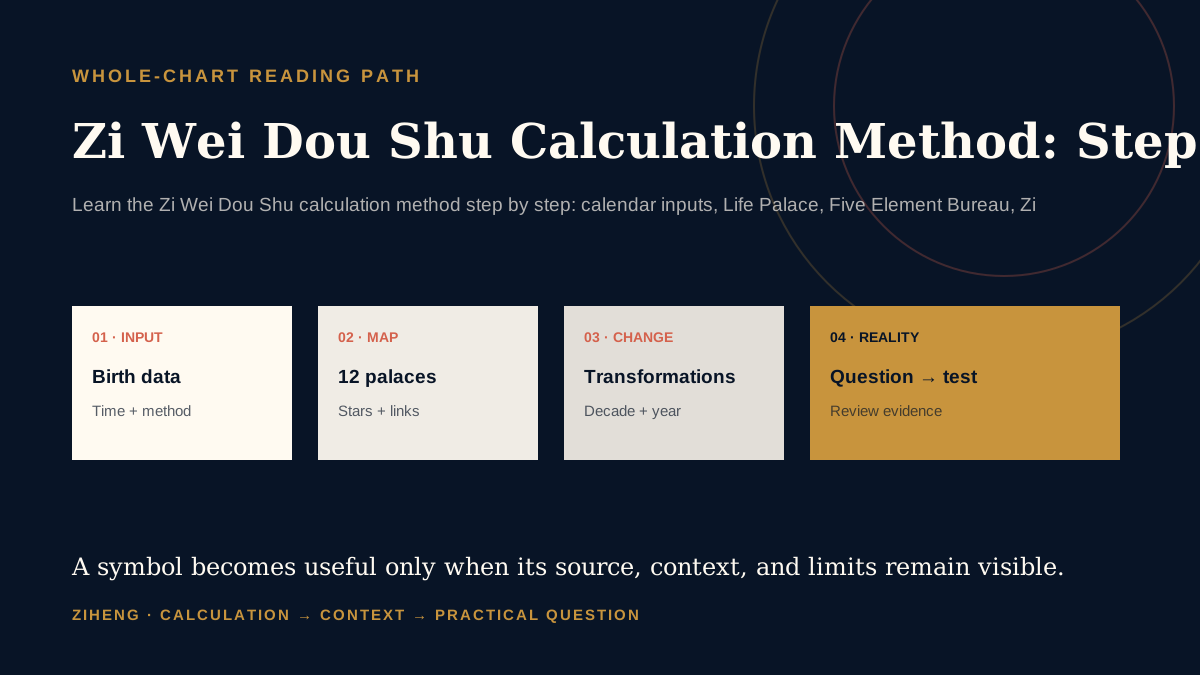
Direct answer: a Zi Wei Dou Shu calculation converts a birth date, local birth time, calendar rules, and gender rule into a twelve-palace chart. The reliable order is to normalize the birth input, establish the lunar date and two-hour window, place the Life and Body Palaces, determine the Five Element Bureau, locate Zi Wei, place the fourteen major stars, add supporting stars and Four Transformations, and only then calculate decade and annual timing.
1. Normalize the birth input
Record the date, exact local clock time, birthplace, historical time zone, and the selected sex or gender rule used for cycle direction. Do not silently convert a birthplace time into the viewer's current time zone. If the birth time is uncertain, keep that uncertainty visible because a different two-hour window can move the palace layout.
2. Convert the calendar consistently
The engine derives the traditional lunar date and stem-branch information from the recorded local moment. A reproducible calculator must disclose how it handles time zones, daylight saving, leap months, solar-term boundaries, and any true-solar-time option. Two websites can disagree because they chose different rules even when both display a polished chart.
3. Establish the twelve-palace board
The birth month and two-hour branch are used to locate the Life Palace and Body Palace. Once the Life Palace is fixed, the remaining domains—Siblings, Spouse, Children, Wealth, Health, Travel, Friends, Career, Property, Fortune, and Parents—follow around the board in a fixed sequence. This step creates the rooms of the chart; it does not yet interpret them.
4. Determine the Five Element Bureau
The Life Palace stem-branch relationship determines a traditional Five Element Bureau. The bureau is a calculation key used together with the lunar birth day to locate the Zi Wei star. It is not a personality score, a favorable-element verdict, or the same thing as a BaZi Five Elements analysis.
5. Locate Zi Wei and place the 14 major stars
After the Zi Wei anchor is known, the Zi Wei group and Tian Fu group follow their traditional relative sequences around the twelve branches. The placement is deterministic under a disclosed rule set: the same normalized input and method version should produce the same major-star map every time.
6. Add supporting stars and Four Transformations
Supporting stars use their own anchors, such as year stem, year branch, month, day, or hour. The Four Transformations attach dynamic emphasis to specific stars according to the relevant heavenly stem. They modify a star in a palace; they do not replace the natal chart or become a simple good-versus-bad score.
7. Calculate decade and annual timing
Da Xian maps successive age ranges across the palace board using the selected direction rule and bureau. Annual and monthly layers are then superimposed without erasing the natal structure. A responsible interface shows which layer produced each label so a temporary annual emphasis is not mistaken for a permanent trait.
A worked validation example
Suppose two calculators receive the same recorded birth data but one chart differs. Compare the normalized time zone first, then the two-hour branch, lunar date, leap-month policy, Life Palace, bureau, and Zi Wei anchor—in that order. The first point of disagreement usually explains every downstream difference. Comparing a final prediction will not reveal the calculation error.
Calculation is not interpretation
A deterministic chart can be audited and reproduced. That does not prove that a symbolic interpretation predicts an event. Ziheng therefore keeps three layers separate: the calculated placement, the traditional meaning, and the practical question a reader may choose to explore.
FROM GUIDE TO YOUR CHART
Where does this show up?
Find it in your own chart.
Use the free chart to locate the evidence behind “Zi Wei Dou Shu Calculation Method: Step by Step.” Explore the connected palaces and active timing, then compare the interpretation with your actual situation.
PUT THE QUESTION BESIDE YOUR OWN MAP
Your chart is the next step.
The complete map is free.
The full twelve-palace chart is free. Your next screen keeps “Zi Wei Dou Shu Calculation Method: Step by Step” as the active question and shows the placements used to answer it.
Frequently asked questions
Can Zi Wei Dou Shu be calculated without a birth time?
Only a limited comparison is possible. The traditional two-hour window helps determine the palace layout, so an unknown time should remain explicit instead of being replaced with a default hour.
Why do Zi Wei Dou Shu calculators disagree?
Common causes include time-zone conversion, daylight saving, lunar-calendar or leap-month policy, birth-window boundaries, true solar time, and different school rules.
Is the calculation the same as a prediction?
No. A chart placement can be deterministic under a rule set while the interpretation remains symbolic, contextual, and uncertain.