
CHART INTERPRETATION · 8 MIN READ
Zi Wei Dou Shu chart interpretation:
how to read the whole chart.
Read a Zi Wei Dou Shu chart step by step: establish the Life Palace, connect Career, Wealth, and Travel, then add stars and timing without isolating one label.
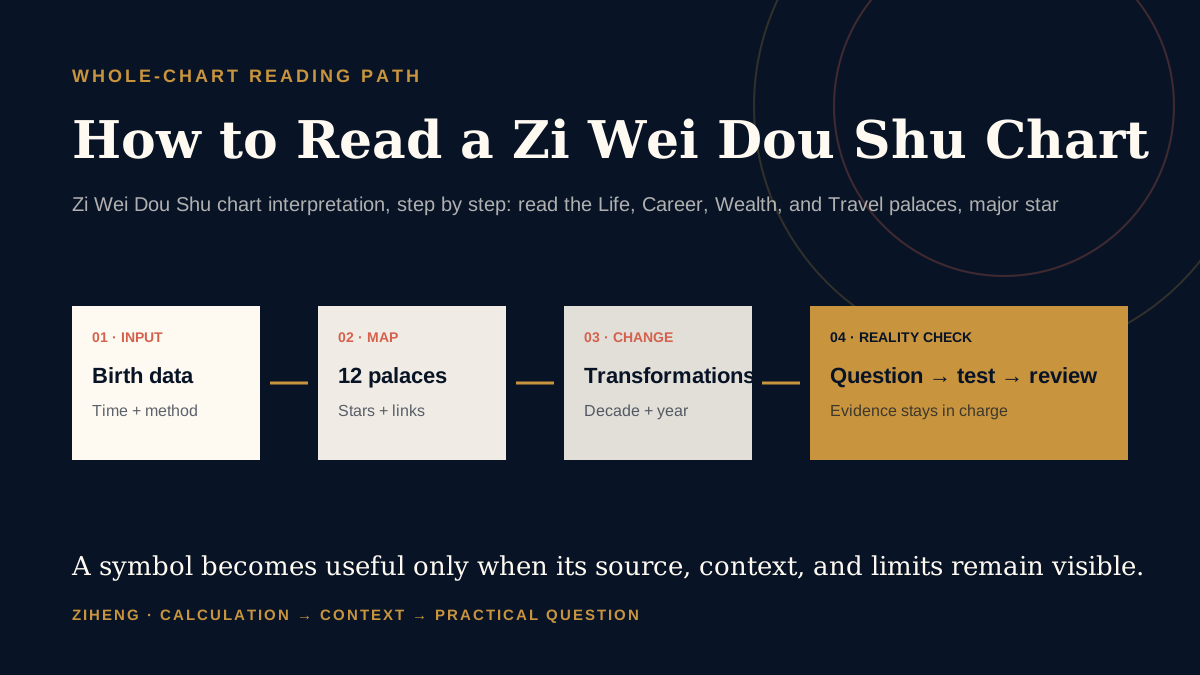
Zi Wei Dou Shu chart interpretation starts with relationships, not isolated star meanings. Zi Wei Dou Shu (紫微斗數), often called Purple Star Astrology, organizes birth data into twelve life domains, or palaces. Major stars and supporting markers are placed in those domains, while decade and annual layers add a traditional sense of timing.
1. Start with the Life Palace, not a prediction
The Life Palace (命宮) is the chart’s main point of reference for disposition, choices, and baseline style. Notice its major stars, but phrase the result as a tendency: how you approach change, authority, planning, visibility, or uncertainty. A star name alone never settles the reading; its palace and surrounding configuration matter.
2. Use the four decision-facing palaces together
For many modern questions, the most helpful first group is Life, Career, Wealth, and Travel. The Career Palace speaks to professional identity and work setting. The Wealth Palace concerns resource patterns and earning habits rather than a guaranteed amount of money. The Travel Palace describes how you meet the outside world: new environments, networks, clients, and movement beyond your usual base. These domains can clarify a question such as “Should I change roles?” better when read as one configuration.
3. Treat stars as roles, not personality verdicts
Traditional readers often describe major stars through archetypes: organizing, adapting, protecting, building, connecting, transforming. That is a useful memory aid, but it becomes misleading when it turns into “this star means you will be X.” Ask instead: what quality is emphasized here, where does it show up, and what other palace either supports or complicates it?
4. Add a 10-year luck cycle as a planning layer
Decade cycles, often called Da Xian, map age ranges onto the chart. They are best used to ask what a period may be inviting you to develop or manage. If the active cycle centers a home-oriented palace, the practical question might be how foundations, boundaries, family commitments, or your working environment affect the larger plan. It is not evidence that an event must happen.
5. End with a grounded action
A good reading produces a better question or a small next action: update your skills inventory, have a direct conversation, run a budget, protect recovery time, or test a low-risk opportunity. For health, financial, legal, or mental-health decisions, use qualified professional advice—not a chart—as the decision authority.
What to read next
New to palace names? Start with the 12 palaces in Zi Wei Dou Shu. Reading a work decision? See the Career Palace guide and 10-year timing guide.
FROM GUIDE TO YOUR CHART
Where does this show up?
Find it in your own chart.
Use the free chart to locate the evidence behind “How to Read a Zi Wei Dou Shu Chart.” Explore the connected palaces and active timing, then compare the interpretation with your actual situation.
PUT THE METHOD TO WORK
See the structure
of your own chart.
Frequently asked questions
What should I read first in a Zi Wei Dou Shu chart?
Start with the Life Palace, then read Career, Wealth, and Travel together. Add the active decade cycle only after you understand the baseline structure.
Do I need my exact birth time for Zi Wei Dou Shu?
Traditional charts use two-hour birth windows to place the palace structure. Use the recorded time if possible; if uncertain, treat any reading as exploratory.