Reviewed by Ziheng Editorial against the public method · Updated 16 August 2026 · Editorial policy
Direct answer
BaZi and Western astrology can start from the same birth moment but build different symbolic maps. BaZi uses stems, branches, Five Elements, Ten Gods, and luck pillars; Western astrology uses planets, zodiac signs, houses, aspects, and transits.
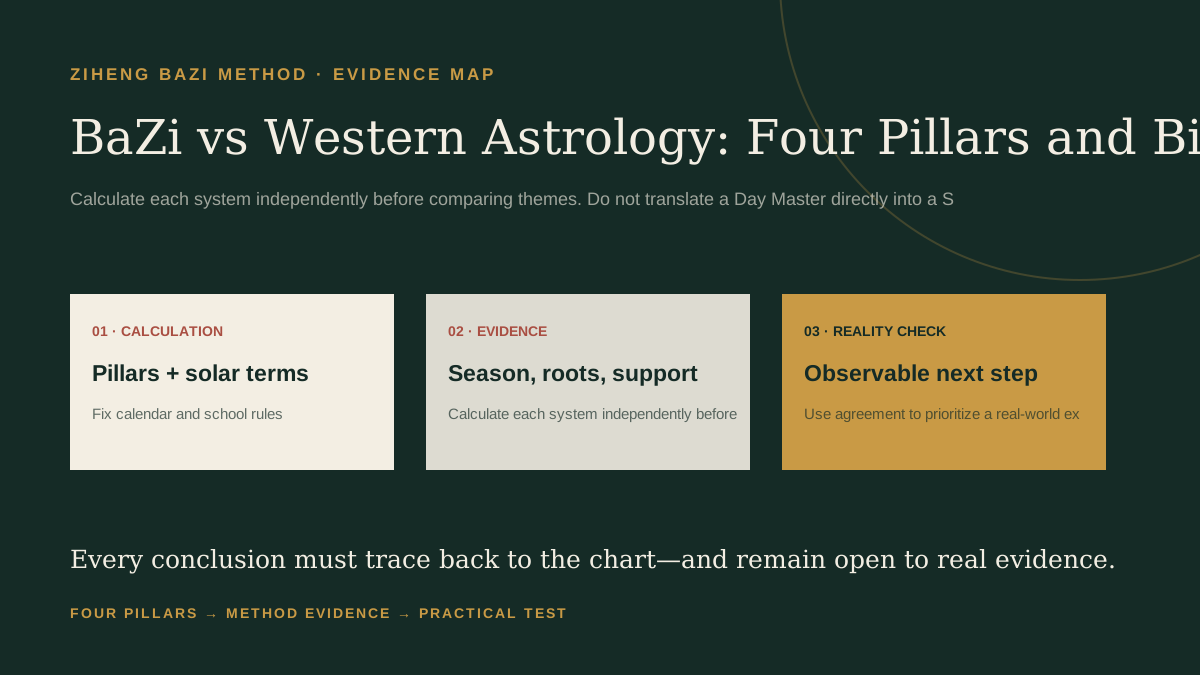
Read it in this order
Calculate each system independently before comparing themes. Do not translate a Day Master directly into a Sun sign or a Ten God into one planet. Compare only at the level of the question—identity, work, relationship, resources, or timing—and keep each system’s evidence labels visible.
From symbol to real life
Use agreement to prioritize a real-world experiment and disagreement to expose assumptions. Neither system proves a personality trait or future event. A useful cross-check creates a clearer question rather than a louder prediction.
FROM ARTICLE TO YOUR FOUR PILLARS
Do not stop at the concept. Check your own evidence.
Calculate the Four Pillars and current Da Yun free, then test the evidence required by “BaZi vs Western Astrology: Four Pillars and Birth Charts”: Calculate each system independently before comparing themes. Do not translate a Day Master directly into a Sun sign or a Ten God into one planet. Compare only at the level of the question—identity, work, relationship, resources, or timing—and keep each system’s evidence labels visible.
See my complete BaZi chart →Worked example: one birth moment, two symbolic maps
A fictional person enters the same date, time, and place into both systems. BaZi produces Four Pillars, a Day Master, Ten God relationships, and Da Yun. A Western natal chart produces planets in signs and houses, aspects, and later transits. A similar theme—such as visibility versus privacy—may appear in both, but the evidence is not interchangeable.
Compare questions, not one-to-one symbols
A Day Master is not a Sun sign, a Wealth star is not Venus, and a Da Yun is not a transit. Compare only after each system has produced an internally coherent reading. Agreement can prioritize a real-world experiment; disagreement can reveal which assumptions need observation.
- Use the same verified birth record while preserving each system’s time policy.
- Calculate each chart independently and keep its evidence labels.
- Compare themes at the level of self, work, relationship, resources, or timing.
- Do not use agreement as proof or disagreement as a reason to cherry-pick.
Method, sources, and editorial review
This page follows Ziheng’s public calculation rules. Traditional vocabulary is cross-checked against commonly used frameworks associated with Yuan Hai Zi Ping, San Ming Tong Hui, and Di Tian Sui; no paragraph is presented as a verbatim classical quotation. Calculation, traditional interpretation, and practical action remain separate.
What this cannot do
This method cannot guarantee wealth, health, legal, work, or relationship outcomes. It is for cultural reflection and planning questions; major decisions still require real evidence and qualified advice.
FAQ
Is a BaZi Day Master the same as a zodiac Sun sign?
No. Both can be used as a reference point for identity, but a Day Master is a Heavenly Stem interpreted through season and the whole BaZi structure, while a Sun sign comes from the Sun’s zodiac position in a Western birth chart.
What evidence should remain visible when reading BaZi vs Western Astrology: Four Pillars and Birth Charts?
Calculate each system independently before comparing themes. Do not translate a Day Master directly into a Sun sign or a Ten God into one planet. Compare only at the level of the question—identity, work, relationship, resources, or timing—and keep each system’s evidence labels visible.