Early and late Zi remain separate.
00:00–00:59 is early Zi; 23:00–23:59 is late Zi. The other traditional windows advance in two-hour blocks.
 繁體中文 ↗
CALCULATION STANDARD · PUBLIC METHOD
Ziheng fixes the chart structure before it writes any plain-language explanation. This page records the engine, input assumptions, boundary behavior, timing layers, and limits so the same input can be checked again.
WHAT HAPPENS AFTER YOU PRESS GENERATE
Validate the date, map the clock time to one of thirteen explicit early-Zi through late-Zi windows, and retain the selected traditional gender rule.
Use recorded birthplace clock time by default. If requested, calculate the equation of time plus longitude correction and show whether a palace boundary changed.
Convert the calendar input, arrange twelve palaces, place major and supporting stars, attach natal Four Transformations, and calculate decade ranges.
Connect palaces, transformations, decade, annual, and monthly layers. Traditional symbolism and practical suggestions remain visibly distinct.
PUBLISHED CONVENTIONS
Zi Wei Dou Shu is not one universal software specification. When schools differ, transparency is more useful than pretending the difference does not exist.
00:00–00:59 is early Zi; 23:00–23:59 is late Zi. The other traditional windows advance in two-hour blocks.
Use the recorded local civil time and historical UTC offset. Your current location and current time zone are not substituted.
The correction combines longitude against the time-zone meridian with the equation of time. Both the original and adjusted values remain visible.
The calculator can place the selected window beside its two neighbors so stable and time-sensitive placements can be distinguished.
Lu, Quan, Ke, and Ji appear only where the calculated natal placement carries them. The connected palaces remain part of every conclusion.
Decade, annual, and monthly placements are calculated from the natal chart. Ziheng does not convert them into guaranteed events or dates.
PUBLIC REPRODUCIBILITY FIXTURE · FICTIONAL
This sample contains no customer data. Use the same settings to verify that the structural output stays fixed across refreshes and report formats.
PUBLIC REFERENCE PLATES · ORIGINAL ZIHENG DIAGRAMS
These diagrams are compact references, not predictions. Each plate links to the guide that explains the calculation order, the evidence that must stay visible, and the limits of the annual or relational label. Browse the complete guide library when the question sits outside these four paths.
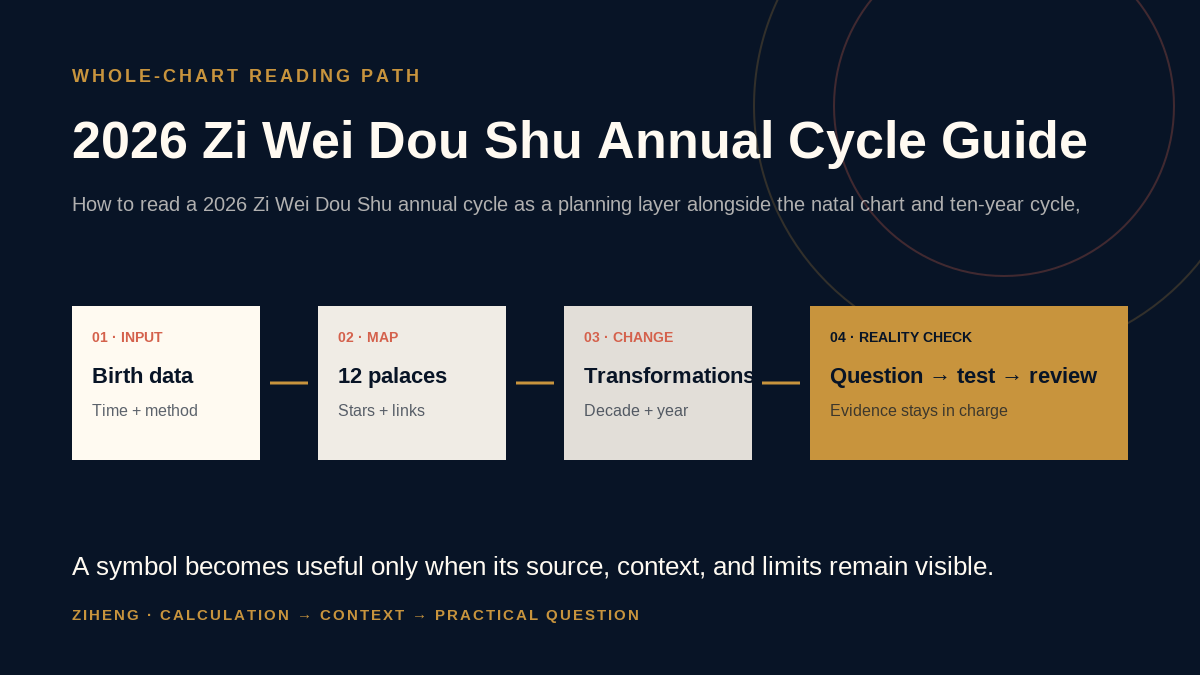
Verify the active decade, review the remaining annual layer, and preserve evidence for the hand-off.
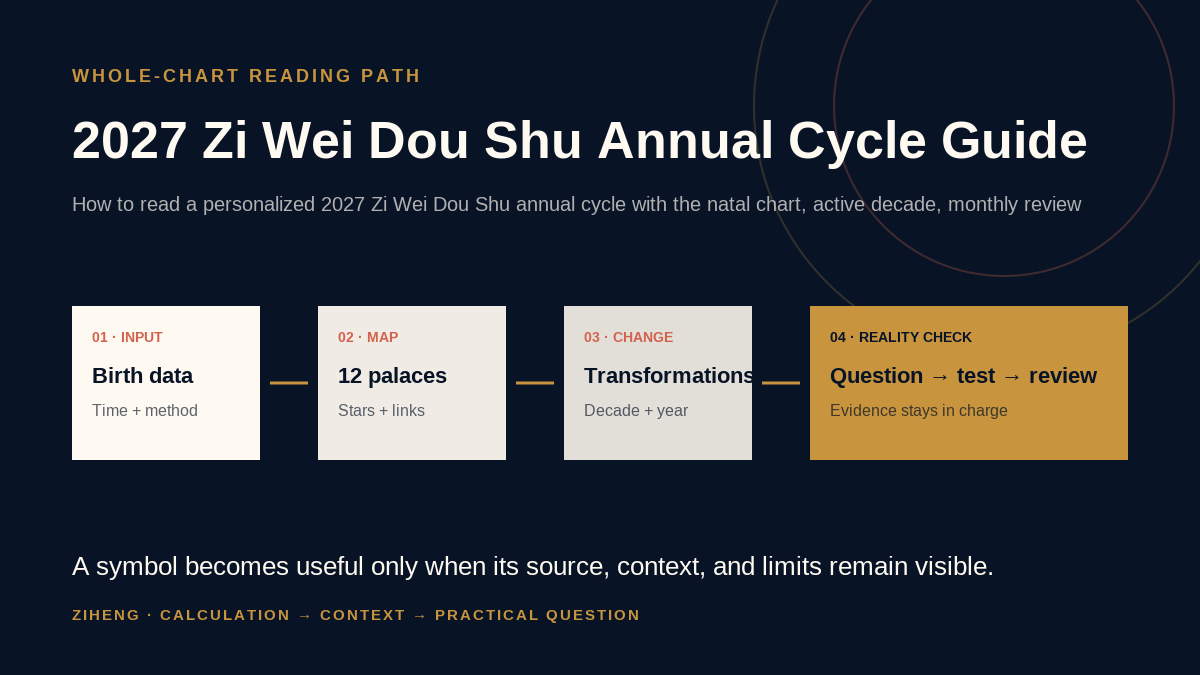
Keep the natal chart and decade underneath Tai Yin Lu, Tian Tong Quan, Tian Ji Ke, and Ju Men Ji.
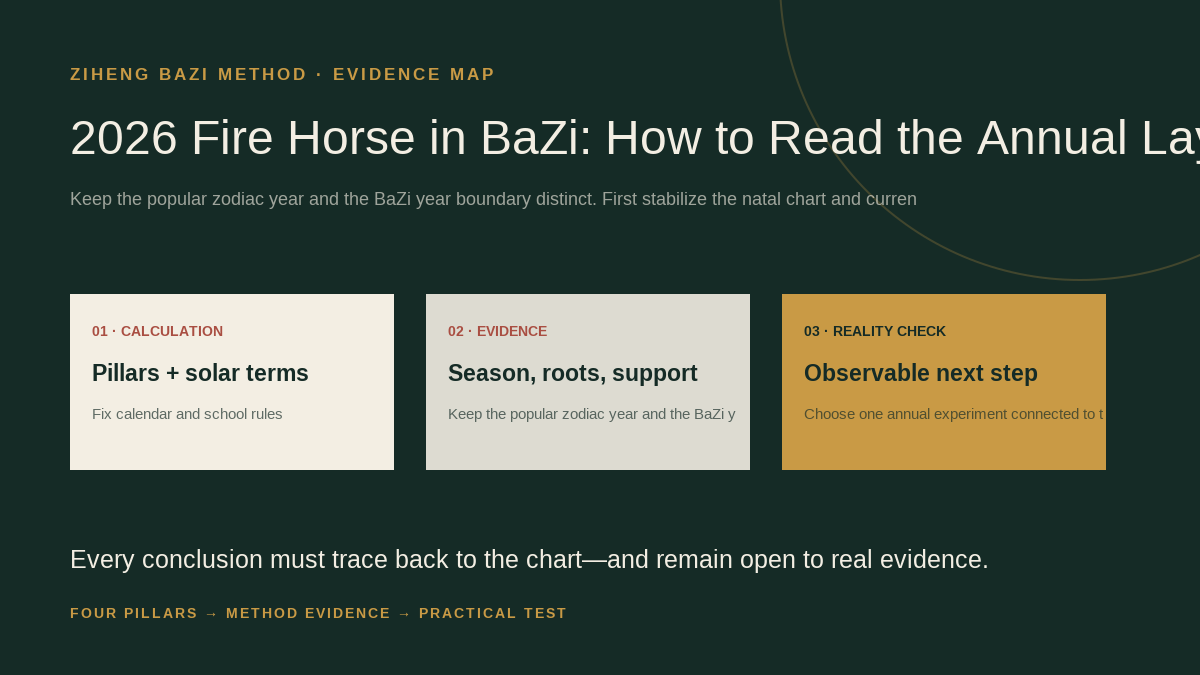
The same Bing-Wu pillar can represent different functions in different charts; Da Yun and natal structure stay in view.
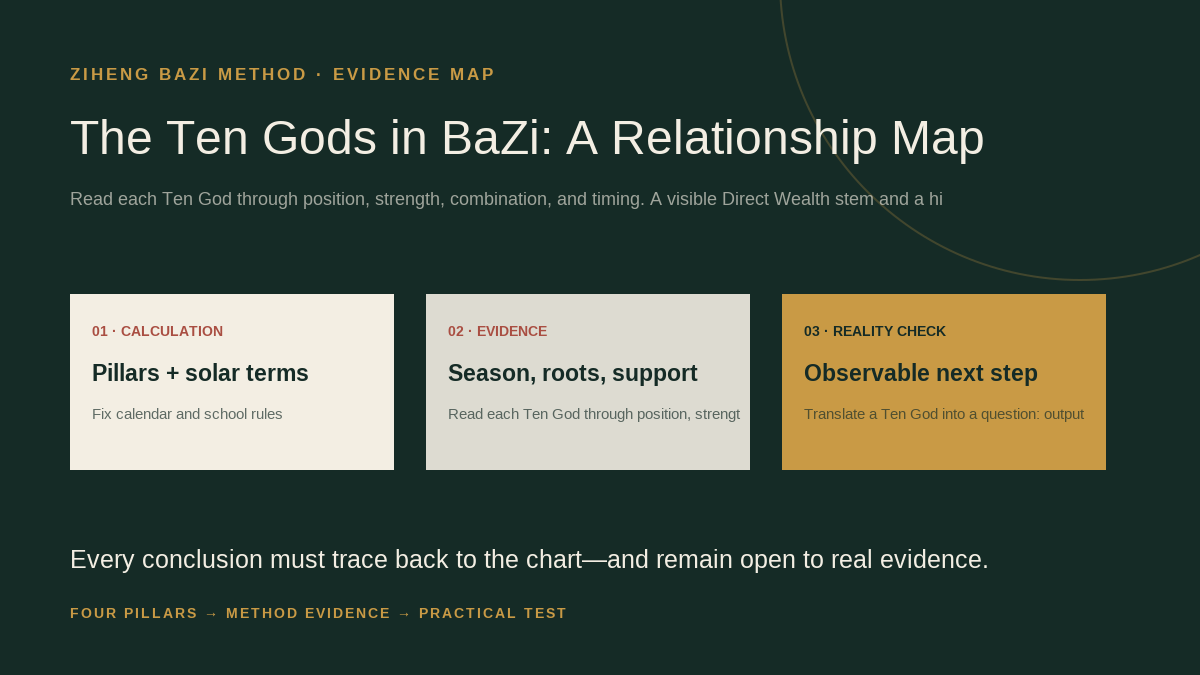
Position, visibility, rooting, seasonal context, combinations, and timing all change the practical question.
DOWNLOADABLE VALIDATION
The public BaZi calculation validation study compares 1,000 seeded ordinary timestamps across two independent open-source implementations, publishes all 48 solar-term boundary checks, and names the late-Zi convention difference. Use the true solar time calculator and bilingual glossary as companion references.
LIMITS ARE PART OF THE METHOD
It cannot know your income, employer, health, relationship behavior, legal situation, access to opportunity, or what another person will choose.
It cannot validate an uncertain birth record. It can only make the uncertainty visible and compare nearby traditional windows.
It cannot prove that a symbolic interpretation is scientifically predictive. Ziheng presents the system as cultural education and a reflection framework.
It must not replace qualified financial, legal, medical, or mental-health advice.
No. Calendar conversion, time-window selection, palaces, stars, transformations, and timing layers are fixed before plain-language interpretation. The paid report cannot invent a different placement.
Schools and tools can differ in leap-month handling, early and late Zi boundaries, true-solar-time use, transformations, supporting stars, or terminology. Compare published assumptions before comparing conclusions.
No. They organize reflection and planning prompts. They cannot guarantee a promotion, payment, meeting, breakup, health event, or any outcome.
CHECK THE METHOD WITH YOUR OWN INPUT