Reviewed by Ziheng Editorial against the public method · Updated 16 August 2026 · Editorial policy
Direct answer
In BaZi, 2026 is the Bing-Wu annual pillar, often called the Fire Horse year. It is not a universal forecast. The useful question is how Bing Fire and Wu Fire interact with a specific natal chart and current Da Yun after the Li Chun boundary.
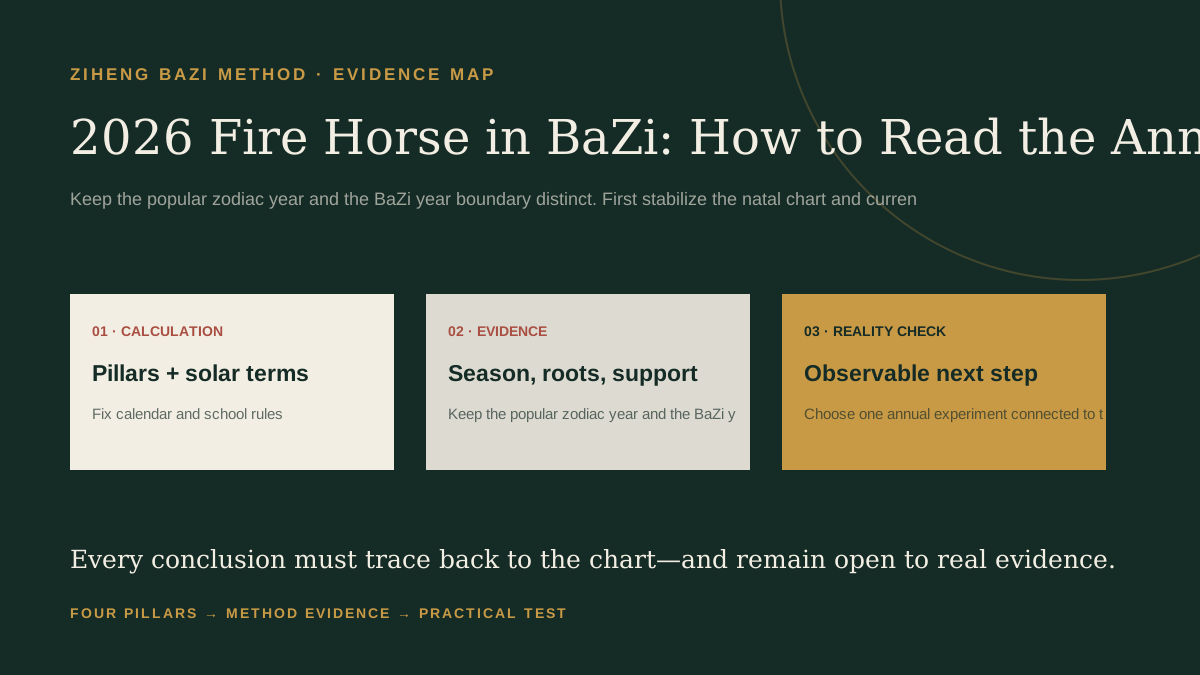
Read it in this order
Keep the popular zodiac year and the BaZi year boundary distinct. First stabilize the natal chart and current Da Yun, then trace which Ten God functions Bing and Wu create for the Day Master, whether they repeat or disrupt the natal structure, and where confidence remains limited.
From symbol to real life
Choose one annual experiment connected to the repeated function—such as visibility, delivery capacity, standards, recovery, or cash-flow discipline—and review it monthly. Do not treat a Fire Horse label as a promise of luck, danger, or a guaranteed event.
FROM ARTICLE TO YOUR FOUR PILLARS
Do not stop at the concept. Check your own evidence.
Calculate the Four Pillars and current Da Yun free, then test the evidence required by “2026 Fire Horse in BaZi: How to Read the Annual Layer”: Keep the popular zodiac year and the BaZi year boundary distinct. First stabilize the natal chart and current Da Yun, then trace which Ten God functions Bing and Wu create for the Day Master, whether they repeat or disrupt the natal structure, and where confidence remains limited.
See my luck and annual timing →Worked example: the same Fire Horse year, different charts
For a fictional Ren Water Day Master, Bing Fire may represent a Wealth function; for a fictional Geng Metal Day Master, the same Bing Fire may represent Authority. Wu adds another Fire branch but also contains hidden qi and relationships that depend on the natal chart. This is why “Fire Horse is lucky for these signs” is too broad to be a BaZi reading.
Read 2026 as an annual planning layer
First mark the Li Chun boundary used by the BaZi year. Then place Bing-Wu beside the natal chart and current Da Yun. Identify one repeated function, one pressure point, and one resource that keeps the year workable. Review the hypothesis against real monthly evidence rather than producing twelve guaranteed events.
- Use Li Chun for the BaZi annual boundary and state the selected convention.
- Derive Bing and Wu relationships from the individual Day Master.
- Check combinations, clashes, climate, and whether Da Yun repeats the annual theme.
- Choose one reversible annual experiment and define a review date.
Method, sources, and editorial review
This page follows Ziheng’s public calculation rules. Traditional vocabulary is cross-checked against commonly used frameworks associated with Yuan Hai Zi Ping, San Ming Tong Hui, and Di Tian Sui; no paragraph is presented as a verbatim classical quotation. Calculation, traditional interpretation, and practical action remain separate.
What this cannot do
This method cannot guarantee wealth, health, legal, work, or relationship outcomes. It is for cultural reflection and planning questions; major decisions still require real evidence and qualified advice.
FAQ
Is 2026 lucky for every Fire or Horse chart?
No. The same Bing-Wu annual pillar creates different Ten God relationships for different Day Masters and interacts with different natal charts and Da Yun. A zodiac animal or element alone cannot determine the year.
What evidence should remain visible when reading 2026 Fire Horse in BaZi: How to Read the Annual Layer?
Keep the popular zodiac year and the BaZi year boundary distinct. First stabilize the natal chart and current Da Yun, then trace which Ten God functions Bing and Wu create for the Day Master, whether they repeat or disrupt the natal structure, and where confidence remains limited.