Reviewed by Ziheng Editorial against the public method · Updated 16 August 2026 · Editorial policy
Direct answer
BaZi chart interpretation is easiest as an ordered system: confirm the calendar choices, locate the Day Master, establish the seasonal Month Branch, inspect roots and Ten Gods, then add luck pillars. Reading a single symbol first produces confident but fragile conclusions.
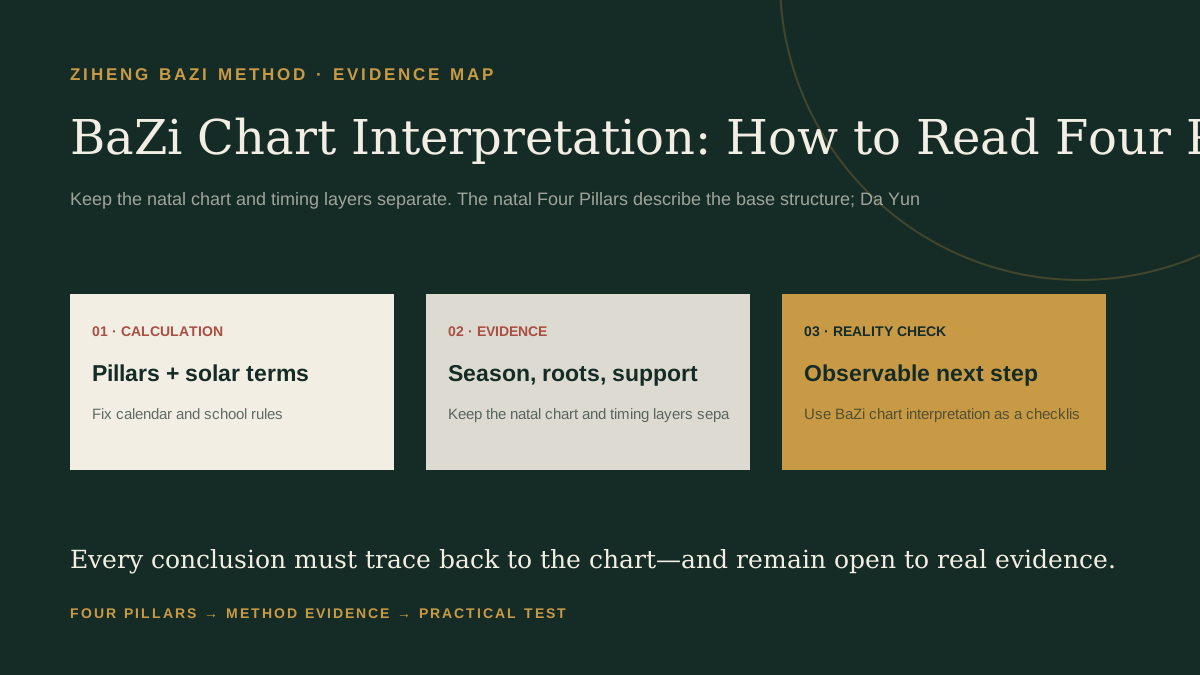
Read it in this order
Keep the natal chart and timing layers separate. The natal Four Pillars describe the base structure; Da Yun and the selected year only show which functions may become more relevant. Mark unknown birth time before interpreting the Hour Pillar.
From symbol to real life
Use BaZi chart interpretation as a checklist: identify one work pattern, one resource pattern, and one pressure pattern you can test against lived experience. Keep what is useful, and revise any symbolic interpretation that real evidence does not support.
FROM ARTICLE TO YOUR FOUR PILLARS
Do not stop at the concept. Check your own evidence.
Calculate the Four Pillars and current Da Yun free, then test the evidence required by “BaZi Chart Interpretation: How to Read Four Pillars”: Keep the natal chart and timing layers separate. The natal Four Pillars describe the base structure; Da Yun and the selected year only show which functions may become more relevant. Mark unknown birth time before interpreting the Hour Pillar.
See my complete BaZi chart →Worked example: why reading order changes the answer
Consider a fictional Xin Metal Day Master born in Shen month. A surface reading might stop at “Metal is strong.” The ordered reading asks more: does Xin have a main-qi root, which visible stems support or drain it, is the chart cold or dry, which Month hidden stem becomes visible, and what does the current Da Yun activate? The conclusion becomes a transparent argument rather than a one-line personality label.
From chart symbols to one testable question
Suppose visible support is abundant while output is available but irregular. The practical question is not “Am I destined to be rigid?” It is “Do high internal standards delay release and external feedback?” That can be tested by defining a completion threshold, shipping one bounded work sample, and recording the revision cycle.
- Stabilize calendar and birth-time assumptions.
- Read Day Master and Month order before counting elements.
- Add roots, hidden stems, visible Ten Gods, and climate.
- State strength and structure confidence before adding Da Yun and the selected year.
Method, sources, and editorial review
This page follows Ziheng’s public calculation rules. Traditional vocabulary is cross-checked against commonly used frameworks associated with Yuan Hai Zi Ping, San Ming Tong Hui, and Di Tian Sui; no paragraph is presented as a verbatim classical quotation. Calculation, traditional interpretation, and practical action remain separate.
What this cannot do
This method cannot guarantee wealth, health, legal, work, or relationship outcomes. It is for cultural reflection and planning questions; major decisions still require real evidence and qualified advice.
FAQ
What should I read first in a BaZi chart?
Start by checking the calendar rules and birth-time certainty. Then identify the Day Master, read the Month Branch as season, inspect roots and Ten Gods, assess strength and climate, and add Da Yun only after the natal structure is stable.
What evidence should remain visible when reading BaZi Chart Interpretation: How to Read Four Pillars?
Keep the natal chart and timing layers separate. The natal Four Pillars describe the base structure; Da Yun and the selected year only show which functions may become more relevant. Mark unknown birth time before interpreting the Hour Pillar.