
COMPARISON · 5 MIN READ
Zi Wei Dou Shu vs BaZi:
two maps, different questions.
Both are traditional Chinese metaphysics systems based on birth information, but their charts organize interpretation in very different ways.
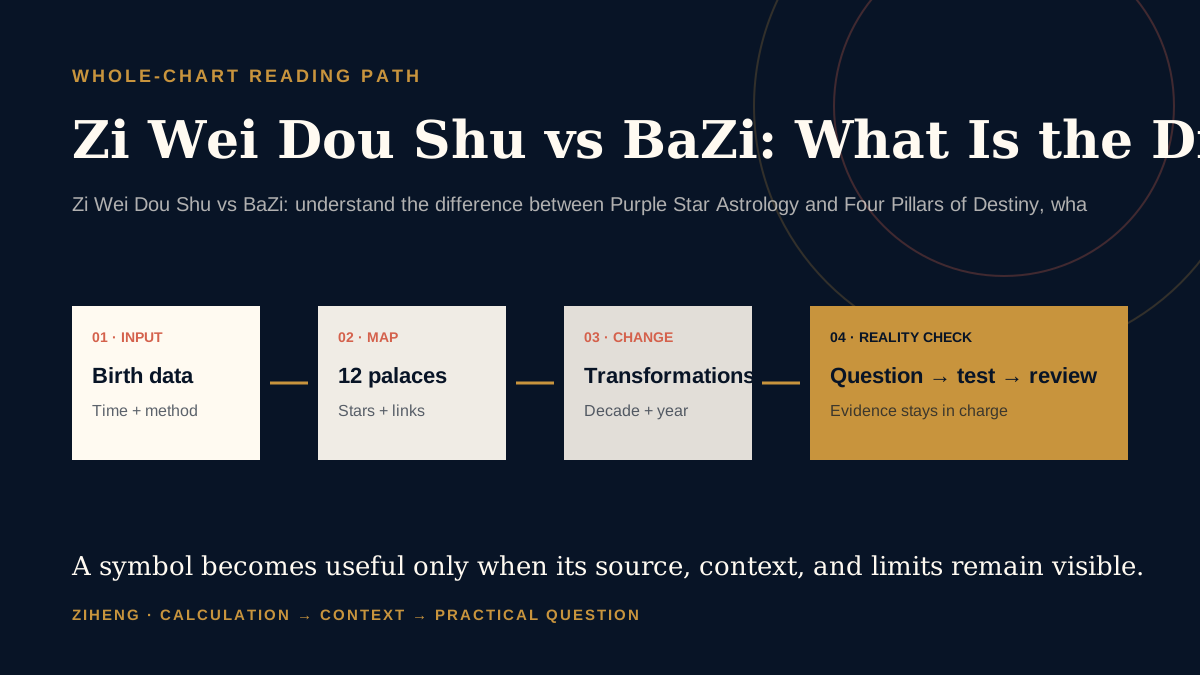
People often encounter BaZi (八字, Four Pillars of Destiny) and Zi Wei Dou Shu (紫微斗數, Purple Star Astrology) together. They are not interchangeable. Each has its own calculation grammar, vocabulary, schools of interpretation, and ways of thinking about time.
ZI WEI DOU SHU
A palace-and-star map
Birth data is arranged into 12 life palaces, with major and supporting stars placed across the chart. It is naturally suited to questions framed by life domain: Career, Wealth, Partnership, Travel, Home, and Wellbeing. Traditional decade and annual layers add timing context.BAZI / FOUR PILLARS
An element-and-pillar map
Birth data is expressed through year, month, day, and hour pillars, using Heavenly Stems, Earthly Branches, Five Elements, and their relationships. Its interpretive language often focuses on balance, seasonal context, and the interactions among those elements.Which one should you start with?
Start with the system that makes your first question understandable. If you want a visual map of life domains and a whole-chart reading of work, money, or relationships, Zi Wei Dou Shu may be an accessible entry. If you are interested in the Four Pillars and five-element framework, BaZi may feel more direct. Serious practice in either system takes study; neither one should be marketed as a machine for certain predictions.
Do they need to agree?
No. They use different symbolic structures, and practitioners may interpret the same birth data through different schools. The healthy use of either system is to generate useful reflection, not to force a final verdict. When a reading leads to an important decision, bring in facts, trusted people, and qualified advice.
What Ziheng does
Ziheng now calculates both systems privately in the browser. The Zi Wei tool maps twelve palaces, stars, Four Transformations, and decade context. The BaZi tool shows Four Pillars, hidden stems, Ten Gods, strength evidence, useful-element lenses, and Da Yun. Each system keeps its own evidence before any cross-check.
Next, learn the 12 palaces, the whole-chart reading order, the Four Pillars, or how the cross-check preserves agreement and tension.
FROM GUIDE TO YOUR CHART
Where does this show up?
Find it in your own chart.
Use the free chart to locate the evidence behind “Zi Wei Dou Shu vs BaZi: What Is the Difference?.” Explore the connected palaces and active timing, then compare the interpretation with your actual situation.
START WITH THE PALACE MAP
Explore Zi Wei Dou Shu
with a free chart.
Frequently asked questions
Is Zi Wei Dou Shu more accurate than BaZi?
Neither system can establish a reliable guarantee of outcomes. They are different traditional frameworks; use them for reflection, not certainty.
Can I calculate both with the same birth time?
Both systems use birth information, but their calculation methods and time conventions can differ. Use a transparent tool and treat the result as exploratory if the birth time is uncertain.