Reviewed by Ziheng Editorial against the public method · Updated 16 August 2026 · Editorial policy
Direct answer
A reliable free BaZi calculator should disclose its calendar engine, year and month boundaries, late-Zi rule, time-zone handling, and what happens when birth time is unknown. A beautiful chart without these choices is not auditable.
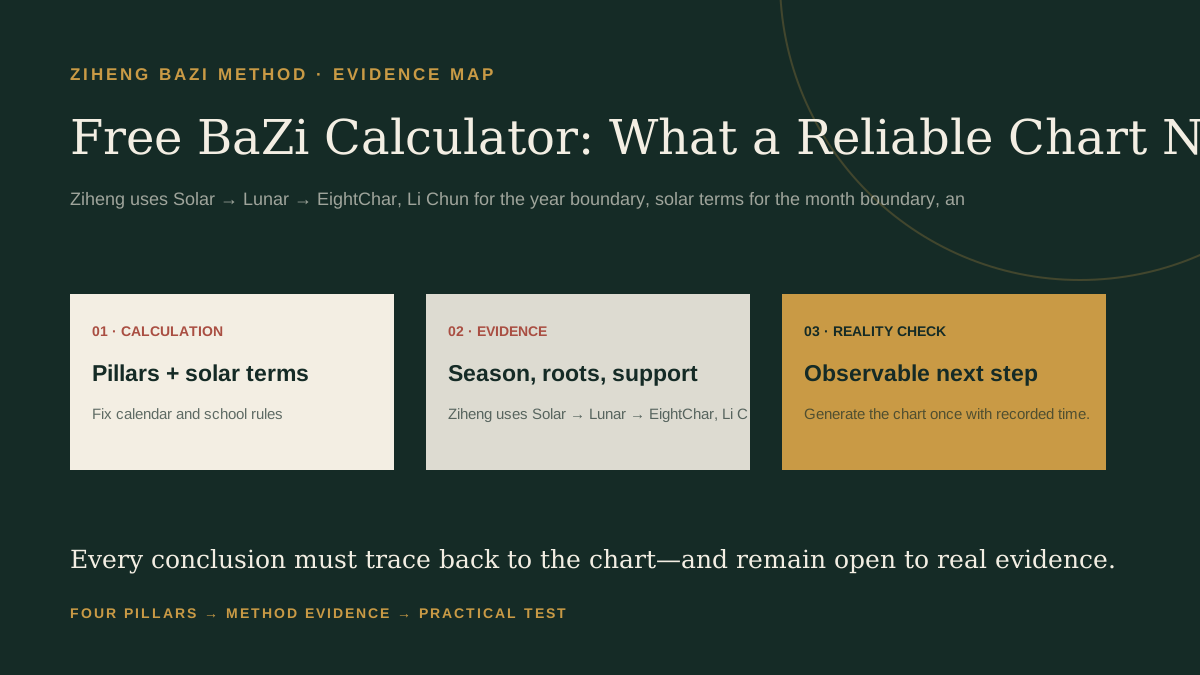
Read it in this order
Ziheng uses Solar → Lunar → EightChar, Li Chun for the year boundary, solar terms for the month boundary, and 23:00 for the late-Zi day change. True solar time is optional and shown separately from recorded civil time.
From symbol to real life
Generate the chart once with recorded time. Only enable true solar time when longitude and historical offset are known. If the time is unknown, omit the Hour Pillar from method weighting instead of inventing precision.
FROM ARTICLE TO YOUR FOUR PILLARS
Do not stop at the concept. Check your own evidence.
Calculate the Four Pillars and current Da Yun free, then test the evidence required by “Free BaZi Calculator: What a Reliable Chart Needs”: Ziheng uses Solar → Lunar → EightChar, Li Chun for the year boundary, solar terms for the month boundary, and 23:00 for the late-Zi day change. True solar time is optional and shown separately from recorded civil time.
See my complete BaZi chart →Worked example: a chart near a time boundary
A fictional birth record says 23:06 in a city west of its time-zone meridian. Recorded civil time produces a late-Zi day change, while an optional longitude and equation-of-time correction may move the solar time back across 23:00. A responsible calculator does not silently choose the more flattering chart. It stores the civil result, shows the corrected result separately, and explains exactly which Day or Hour Pillar changes.
A reliability checklist before interpretation
The calculation should be repeatable before any personality or timing language appears. If a location, historical time-zone offset, or birth time is uncertain, the uncertainty belongs in the result—not in a footnote after a confident prediction.
- Confirm local recorded date, time, place, and historical time zone.
- Show Li Chun year boundary, solar-term month boundary, and the selected late-Zi rule.
- Compare true solar time only when reliable longitude is available.
- Mark any changed pillar and exclude unknown inputs from later weighting.
Method, sources, and editorial review
This page follows Ziheng’s public calculation rules. Traditional vocabulary is cross-checked against commonly used frameworks associated with Yuan Hai Zi Ping, San Ming Tong Hui, and Di Tian Sui; no paragraph is presented as a verbatim classical quotation. Calculation, traditional interpretation, and practical action remain separate.
What this cannot do
This method cannot guarantee wealth, health, legal, work, or relationship outcomes. It is for cultural reflection and planning questions; major decisions still require real evidence and qualified advice.
FAQ
Why can two BaZi calculators disagree?
Two calculators can disagree because they use different year boundaries, solar-term times, late-Zi day rules, time zones, daylight-saving records, or true-solar-time policies. A reliable calculator should disclose those choices.
What evidence should remain visible when reading Free BaZi Calculator: What a Reliable Chart Needs?
Ziheng uses Solar → Lunar → EightChar, Li Chun for the year boundary, solar terms for the month boundary, and 23:00 for the late-Zi day change. True solar time is optional and shown separately from recorded civil time.